When a facility requires ESD flooring, one of the first technical decisions is often whether the system should be conductive or static-dissipative.
The terms sound similar because both flooring classifications are designed to help manage electrostatic charge. Their electrical resistance ranges are different, but resistance alone does not determine which flooring will perform best in a particular facility.
The right choice depends on the ESD control program, sensitive items being handled, personnel grounding method, footwear, operating environment, substrate, and verified performance of the completed system.
Understanding these differences helps engineers, facility managers, EHS teams, production personnel, QA teams, and procurement professionals make a more informed flooring decision.
Quick Answer: What Is the Difference?
Conductive flooring has an electrical resistance below 1.0 × 10⁶ ohms. Static-dissipative flooring has resistance of 1.0 × 10⁶ ohms or greater and below 1.0 × 10⁹ ohms.
Both are forms of static-control flooring.
Conductive flooring provides a lower-resistance electrical path. Static-dissipative flooring provides a controlled path within a higher resistance range.
The important point is that conductive does not automatically mean better, and static-dissipative does not automatically mean safer.
The flooring should be selected according to the performance requirements of the complete ESD control system.
What Is Conductive Flooring?
Conductive flooring is a static-control flooring system classified within a relatively low electrical resistance range.
Under the current ANSI/ESD STM7.1 definition, conductive flooring has resistance:
Less than 1.0 × 10⁶ ohms
Its purpose is to provide an electrical path through which charge can move toward an appropriate ground when the flooring is incorporated into a properly designed ESD system.
Conductive flooring may be produced using different flooring technologies. The electrical classification should therefore not be confused with a particular material.
Depending on the product, conductive flooring may be available as vinyl flooring, resin-based flooring, coatings, or other engineered systems.
The completed installation must still be properly grounded and verified according to the applicable project requirements.
What Is Static-Dissipative Flooring?
Static-dissipative flooring also provides a controlled path for electrostatic charge, but its electrical resistance is higher than the conductive classification.
Under the current ANSI/ESD STM7.1 definition, static-dissipative flooring has resistance:
1.0 × 10⁶ ohms or greater and less than 1.0 × 10⁹ ohms
This classification is widely used in ESD-controlled environments where flooring forms part of the facility’s electrostatic control strategy.
Static-dissipative flooring can also be produced using different materials, including specialized vinyl and other engineered flooring systems.
The term describes an electrical resistance classification. It does not, by itself, describe durability, chemical resistance, cleanliness, mechanical strength, or suitability for a particular process.
Conductive vs. Static-Dissipative Flooring at a Glance
| Factor | Conductive Flooring | Static-Dissipative Flooring |
|---|---|---|
| Electrical Resistance | Less than 1.0 × 10⁶ Ω | ≥ 1.0 × 10⁶ Ω and < 1.0 × 10⁹ Ω |
| Primary Function | Provides a relatively low-resistance path for charge dissipation | Provides controlled charge dissipation within a higher resistance range |
| ESD Classification | Conductive | Dissipative |
| Material Type | Can be vinyl, resin, coating, or another qualified system | Can be vinyl or another qualified static-control system |
| Grounding | Required according to system design and specification | Required according to system design and specification |
| Testing | Electrical verification required | Electrical verification required |
| Selection Basis | ESD program and verified system performance | ESD program and verified system performance |
The table provides a general comparison only.
Actual acceptance values should always follow the applicable standard, approved technical specification, selected product data, and facility ESD control program.
Is Conductive Flooring Better Because It Has Lower Resistance?
Not necessarily.
This is one of the most important points when comparing conductive and static-dissipative flooring.
It can be tempting to assume that the floor with the lowest resistance must provide the best protection. ESD control is more complex than a single flooring resistance value.
When personnel grounding relies on footwear and flooring, the person, footwear, floor, grounding arrangement, and interaction between the surfaces work together as a system.
A flooring material may meet its individual resistance classification while the complete footwear and flooring combination performs differently.
For this reason, the correct flooring cannot be selected simply by choosing the lowest number on a resistance specification.
Why Does the Footwear and Flooring Combination Matter?
People can generate electrostatic charge while walking across a surface.
When ESD footwear and flooring are used together as a personnel grounding method, their combined performance becomes important.
The flooring provides part of the electrical path, while compatible footwear creates contact between the person and the floor.
If unsuitable footwear prevents effective electrical contact, the expected flooring performance may not translate into effective personnel grounding.
The same principle can apply to mobile equipment.
Carts, chairs, trolleys, and other movable objects may require suitable conductive or dissipative casters or wheels when they are intended to make electrical contact with the flooring.
This is why an ESD flooring specification should consider the complete operating environment rather than treating the floor as an isolated component.
What About Body Voltage Generation?
Resistance is only one part of evaluating a footwear and flooring system.
Walking across a floor can produce triboelectric charging. This occurs when materials contact and separate during movement.
The interaction between the footwear and flooring surface influences the amount of body voltage that may be generated.
A floor can therefore have an acceptable resistance value while a particular footwear and flooring combination still produces undesirable body voltage.
When flooring and footwear are used as the personnel grounding method under an applicable ANSI/ESD S20.20 program, the combined resistance and walking voltage requirements should both be evaluated.
This makes actual system qualification more meaningful than relying only on the words “conductive” or “static-dissipative.”
Is “Anti-Static Flooring” the Same Thing?
The term anti-static flooring is commonly used in the flooring industry, but it should not replace a measurable electrical specification.
A product described only as anti-static does not automatically tell the facility team its resistance classification, grounding method, test procedure, or verified system performance.
Technical decisions should rely on measurable product characteristics and the applicable ESD requirements.
If a project specifically requires conductive or static-dissipative flooring, the selected system should be qualified and tested according to the required criteria rather than relying on a general marketing description.
Can Vinyl Flooring Be Conductive or Static-Dissipative?
Yes.
Specialized ESD vinyl flooring can be designed for conductive or static-dissipative performance depending on the product construction and technical specification.
Conductive and static-dissipative vinyl flooring is commonly considered for technically sensitive areas where controlled electrical performance, cleanliness, durability, and a professional finished surface are required.
Possible applications include electronics production areas, PCB handling areas, telecommunications facilities, laboratories, selected cleanrooms, test areas, and other ESD protected environments.
The required classification should still be based on the facility’s ESD program and verified product performance.
Can Epoxy Flooring Be Used for ESD Control?
Yes, when the epoxy system is specifically engineered for electrostatic control.
ESD epoxy flooring may include conductive materials, grounding components, intermediate conductive layers, and a specialized finish according to the selected system.
Unlike ordinary industrial epoxy, an ESD epoxy system is designed to provide defined electrical characteristics as part of the completed flooring assembly.
The substrate, preparation method, grounding design, coating system, installation quality, and electrical testing all influence the final result.
Standard decorative or industrial epoxy should not be assumed to provide ESD control unless it is specifically designed and qualified for that purpose.
Where Is Conductive or Static-Dissipative Flooring Used?
Static-control flooring is commonly considered where electrostatic discharge could affect sensitive components, processes, equipment, or controlled operations.
Applications may include:
Electronics Manufacturing
PCB assembly, electronics handling, component production, test areas, repair stations, and other ESD protected areas may require controlled flooring performance.
Semiconductor and Microelectronics Areas
Facilities handling highly sensitive components may incorporate flooring as part of a wider ESD control program.
Telecommunications Facilities
Technical rooms, assembly areas, equipment handling spaces, and selected telecommunications operations may require static-control flooring.
Laboratories
Laboratories working with electrostatic discharge susceptible devices or sensitive instrumentation may incorporate conductive or static-dissipative flooring.
Controlled Manufacturing Areas
Certain production environments use static-control flooring to support personnel grounding and electrostatic charge management.
Selected Cleanroom Applications
Some cleanrooms require ESD control in addition to contamination-control measures.
The flooring should therefore satisfy both the relevant environmental requirements and the required electrical performance.
The presence of electronics alone does not automatically determine whether conductive or static-dissipative flooring is required. The facility’s actual process and ESD risk should guide the decision.
How Do You Choose Between Conductive and Static-Dissipative Flooring?
Choosing the correct flooring requires an evaluation of the facility rather than a simple comparison of resistance ranges.
1. Identify the ESD Control Requirement
Determine which components, assemblies, processes, or equipment require electrostatic protection.
Review the facility’s ESD control plan, client requirements, internal specifications, and applicable standards.
2. Determine the Role of the Flooring
Establish whether the flooring will be used as part of personnel grounding, mobile equipment grounding, general charge control, or another defined function.
This affects how the flooring should be qualified and tested.
3. Review the Footwear System
If personnel will rely on flooring and ESD footwear for grounding, evaluate the intended footwear together with the flooring.
Do not assume that two individually acceptable products will automatically perform correctly as a pair.
4. Evaluate the Existing Substrate
Concrete condition, moisture, cracks, contamination, flatness, previous coatings, and structural integrity can affect flooring installation.
A proper site assessment helps identify these conditions before the system is finalized.
5. Consider Traffic and Equipment
The flooring must support actual facility use.
Consider pedestrian traffic, rolling equipment, carts, production equipment, machinery, maintenance activities, and expected loads.
6. Consider Cleaning and Environmental Conditions
Cleaning products, contamination-control practices, chemicals, temperature, humidity, and operating conditions should be compatible with the flooring.
Electrical performance is important, but the floor must also function reliably as a physical working surface.
7. Establish Testing Requirements
Testing requirements should be defined before installation rather than added only after the flooring is complete.
The project specification should identify the applicable test methods, acceptance limits, documentation, and responsible parties.
How Is Conductive and Static-Dissipative Flooring Tested?
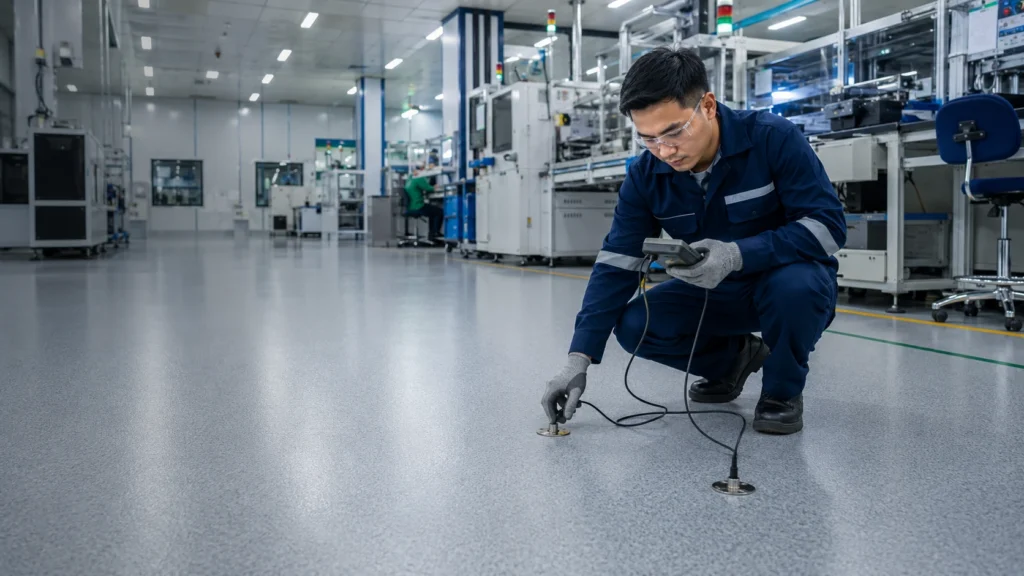
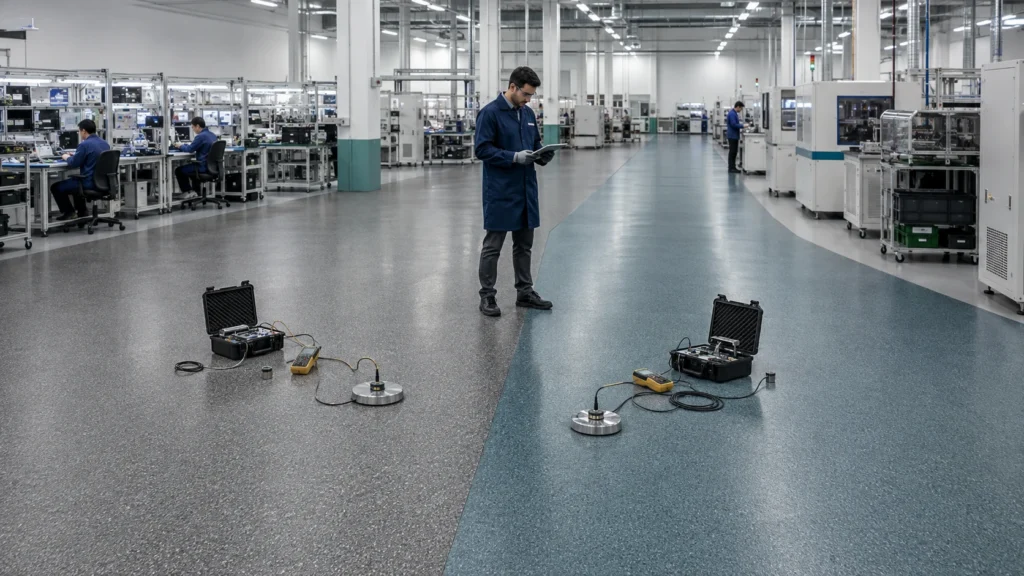
ANSI/ESD STM7.1 provides procedures for measuring electrical resistance of flooring systems used for electrostatic control.
Testing can be used during product qualification and for acceptance or monitoring after flooring installation or application.
Common electrical measurements associated with flooring evaluation include resistance to a groundable point and point-to-point resistance according to the applicable test method.
When the flooring works together with personnel footwear, additional system testing may be relevant.
ANSI/ESD STM97.1 addresses resistance measurement of the footwear and flooring combination with a person.
ANSI/ESD STM97.2 addresses voltage generated by a person using the footwear and flooring system.
The exact tests required should be determined by the facility’s ESD control plan and approved technical specification.
What Should Be Tested After Installation?
A finished floor should not be accepted based only on appearance.
Depending on the project specification, verification may include:
• Flooring resistance measurements
• Resistance to ground measurements
• Point-to-point resistance measurements
• Grounding continuity
• Footwear and flooring system resistance where applicable
• Walking voltage performance where applicable
• Visual inspection
• Installation quality
• Documentation of measurement locations and results
Testing should use suitable equipment and the applicable standard test procedure.
Environmental conditions and test setup can affect electrical measurements, so results should be documented properly.
Does Humidity Affect ESD Flooring?
Environmental conditions can influence electrostatic behavior and the performance of some materials.
Low humidity can increase the tendency for static charge to develop in many environments. Flooring materials may also respond differently depending on their construction and surrounding conditions.
Facilities should therefore consider the operating environment during product selection and testing.
A flooring system intended for a controlled facility should be evaluated under conditions relevant to its actual use and according to the applicable test requirements.
Does Conductive or Static-Dissipative Flooring Need Grounding?
An ESD flooring system requires an appropriate electrical path as defined by its system design and specification.
Grounding may involve conductive adhesive, copper components, grounding points, conductive layers, or another manufacturer-approved configuration depending on the flooring technology.
There is no universal grounding layout that should be applied blindly to every ESD flooring installation.
Grounding requirements should follow the selected product, approved system design, electrical requirements, manufacturer recommendations, and project specification.
Does ESD Flooring Require Special Cleaning?
Maintenance can affect both the appearance and electrical performance of static-control flooring.
Cleaning products should be compatible with the flooring manufacturer’s recommendations.
Certain waxes, coatings, polishes, or residues can alter the surface characteristics of some ESD flooring systems.
Facilities should establish an appropriate cleaning program and periodically verify the flooring according to their ESD control requirements.
The goal is to preserve the intended electrical path while keeping the floor suitable for the operating environment.
Common Mistakes When Choosing Conductive or Static-Dissipative Flooring
Choosing the Lowest Resistance Without Evaluating the System
Lower resistance does not automatically mean better ESD performance.
The complete operating system should be considered.
Relying Only on the Term “Anti-Static”
A general product label is not a substitute for measurable electrical characteristics and proper qualification.
Ignoring ESD Footwear
If footwear and flooring are intended to work together, the combination should be evaluated as a system.
Ignoring the Existing Substrate
Electrical performance does not eliminate normal flooring installation requirements.
Poor concrete condition, moisture, contamination, or inadequate preparation can still affect the flooring installation.
Skipping Post-Installation Testing
An ESD flooring system should be verified according to the applicable specification after installation.
Assuming One Flooring Classification Fits Every ESD Area
Different facilities can have different processes, equipment, ESD risks, traffic conditions, and operating requirements.
The flooring specification should reflect those differences.
ESD flooring helps manage electrostatic charge and provides a controlled path for charge dissipation when incorporated into a properly designed grounding and ESD control system.
Not necessarily.
Both flooring types are designed for static control, but they operate within different electrical resistance ranges.
The correct flooring depends on the process, equipment sensitivity, grounding method, footwear, facility requirements, and applicable ESD control program.
In many cases, yes.
The existing concrete should first be evaluated for cracks, contamination, moisture, flatness, strength, previous coatings, and other conditions that may affect installation.
Proper surface preparation is essential before the new flooring system is applied.
How do I know if ESD flooring is working properly?
Electrical testing should be performed using the applicable test methods and project acceptance criteria.
Depending on the facility, testing may include flooring resistance measurements and evaluation of the footwear and flooring system.
No.
ESD flooring helps control electrostatic charge, but it should not be presented as a system that eliminates every possible source of static electricity.
It works as one component of a broader ESD control strategy.
No.
The appropriate flooring depends on the components being handled, process sensitivity, equipment, personnel grounding method, customer requirements, facility ESD program, and applicable standards.
Conductive flooring should only be selected when it is appropriate for the specific application.
Which Flooring Is Right for Your Facility?
The choice between conductive and static-dissipative flooring should begin with the facility’s real technical requirements.
Resistance classification matters, but it is only one part of the decision.
Process sensitivity, footwear, grounding, substrate condition, traffic, cleaning practices, environmental conditions, installation method, and verification requirements all contribute to the performance of the finished floor.
Reviewing completed flooring projects can also help facility teams understand how ESD systems are implemented in actual industrial environments.
ESD Flooring Philippines provides industrial flooring solutions for electronics, semiconductor, manufacturing, telecommunications, laboratory, controlled production, and other technically demanding facilities.
A professional assessment can help determine which flooring technology and electrical classification should be considered for a specific application.
Need Help Selecting the Right Flooring?
Share your site conditions, floor area, operating requirements, ESD specifications, drawings, or existing flooring concerns.
Our team can review your requirements and recommend a practical flooring system for your facility.