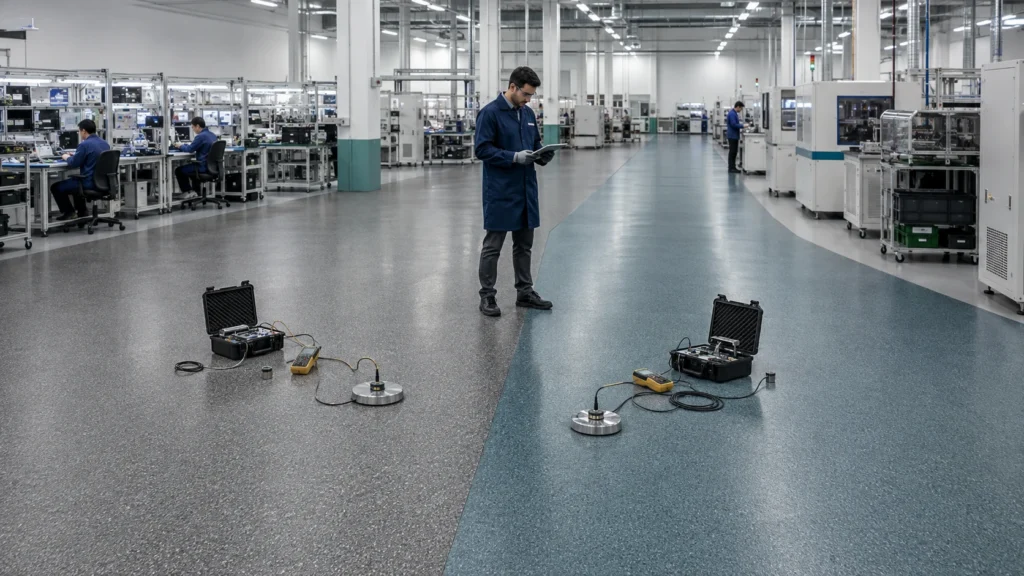
Static electricity is easy to overlook because it cannot always be seen or felt. Inside electronics manufacturing areas, laboratories, telecommunications facilities, cleanrooms, and other sensitive environments, uncontrolled electrostatic charge can become a serious operational concern.
This is where ESD flooring becomes important.
ESD flooring is designed to help manage electrostatic charge and provide a controlled electrical path toward ground. When properly selected, installed, grounded, tested, and maintained, the flooring becomes an important part of a wider electrostatic discharge control strategy.
For facility managers, engineers, EHS teams, production leaders, QA personnel, and procurement professionals, understanding ESD flooring is an important step before selecting a system.
What Is ESD Flooring?
ESD flooring is a static-control flooring system designed to manage electrostatic charge in environments where electrostatic discharge may affect sensitive electronic components, equipment, products, or processes.
The flooring helps provide a controlled path through which accumulated electrical charge can dissipate toward an appropriate grounding point.
However, ESD flooring should not be treated as a stand-alone solution.
A complete ESD control program may also involve grounding systems, ESD footwear, workstations, equipment, personnel procedures, training, and other protective measures.
The flooring becomes one part of a coordinated system designed to reduce electrostatic risk.
Why Does Static Electricity Matter?
Electrostatic charge can develop when different materials come into contact and separate.
Walking across a floor, moving carts, handling materials, wearing certain types of clothing, and performing normal production activities can all contribute to charge generation.
In sensitive environments, even an electrostatic discharge that cannot be seen or felt may affect electronic components.
This is particularly important in facilities handling:
Electronics and semiconductor components, printed circuit boards, microelectronic devices, telecommunications equipment, precision instruments, sensitive assemblies, and other electrostatic discharge susceptible items.
For these operations, the flooring may play an important role in controlling accumulated static charge.
How Does ESD Flooring Work?
ESD flooring works through the electrical characteristics of the flooring system and its connection to an appropriate grounding arrangement.
When electrostatic charge develops on a person or compatible mobile object, the flooring provides a controlled route through which that charge can dissipate.
The complete flooring system may include the finished floor material, conductive adhesive, conductive layers, copper grounding components, grounding points, and other materials depending on the selected system.
ESD footwear may also form part of the personnel grounding system.
This is why choosing flooring based only on an “anti-static” label is not enough.
The actual electrical performance of the flooring should be considered together with the facility requirements, grounding method, footwear, operating conditions, and applicable ESD control program.
Conductive Flooring vs. Static-Dissipative Flooring
Conductive flooring and static-dissipative flooring are both designed to manage electrostatic charge, but they operate within different electrical resistance ranges.
Conductive flooring generally has resistance below 1.0 × 10⁶ ohms.
Static-dissipative flooring generally has resistance of 1.0 × 10⁶ ohms or greater and below 1.0 × 10⁹ ohms.
Conductive flooring provides a relatively low-resistance path for charge dissipation.
Static-dissipative flooring provides controlled charge dissipation within a higher resistance range.
Neither classification should automatically be considered better than the other.
The correct flooring depends on the application, equipment sensitivity, personnel grounding method, facility ESD requirements, and verified system performance.
A lower electrical resistance does not automatically mean better performance for every facility.
What Types of ESD Flooring Are Available?
Different ESD flooring systems can be considered depending on the facility, substrate, operating conditions, project schedule, and required electrical performance.
ESD Vinyl Flooring
Conductive and static-dissipative vinyl flooring uses materials with defined electrical properties as part of the installed flooring system.
This type of flooring can be suitable for electronics production areas, controlled workspaces, telecommunications facilities, laboratories, and other environments where static control and cleanliness are important.
Proper substrate preparation, grounding, installation, and testing remain essential.
ESD Epoxy Flooring
ESD epoxy flooring is a resin-based coating system commonly installed over prepared concrete.
Depending on the product and specification, the flooring system may include a primer, conductive layer, grounding components, and an ESD topcoat.
One important characteristic of epoxy flooring is its ability to create a continuous and highly uniform surface with minimal joints.
This makes ESD epoxy flooring a practical option for many industrial and technically controlled environments.
ESD Interlocking Flooring
ESD interlocking flooring consists of modular tiles that mechanically connect to create the finished surface.
Certain systems can be installed without conventional adhesive, which may help reduce installation disruption.
Interlocking flooring can be considered for facilities where layout flexibility, faster installation, future relocation, or access to the existing floor is important.
Electrical performance, grounding requirements, load capability, and compatibility with the existing substrate should still be verified before installation.
Raised Access Flooring
Raised access flooring elevates removable floor panels above the structural slab.
The space underneath can be used for electrical wiring, data cables, communication systems, cooling infrastructure, and other building services.
Raised flooring can also be specified with static-control surfaces for technically sensitive environments.
This flooring system is commonly considered for data centers, telecommunications rooms, laboratories, control rooms, and facilities requiring frequent access to utilities below the floor.
Where Is ESD Flooring Commonly Used?
ESD flooring is commonly considered in areas where uncontrolled electrostatic charge may affect sensitive products, equipment, or processes.
Typical applications include electronics manufacturing, semiconductor facilities, PCB assembly areas, telecommunications facilities, laboratories, cleanrooms, component handling areas, testing rooms, server environments, and other electrostatic protected areas.
ESD flooring may also be suitable for selected pharmaceutical, medical, manufacturing, logistics, and technical facilities when static control is required.
However, not every room inside these facilities automatically requires ESD flooring.
The flooring requirement should be determined by the actual process, equipment sensitivity, facility ESD program, operational requirements, project specification, and applicable standards.
Is ESD Flooring Required by ANSI/ESD S20.20?
Not automatically.
ANSI/ESD S20.20 establishes requirements for an electrostatic discharge control program for organizations that handle electrical or electronic parts, assemblies, and equipment susceptible to electrostatic discharge.
The standard does not simply require every industrial facility to install ESD flooring.
Flooring becomes one possible control element when it is selected as part of the facility’s ESD control strategy.
When footwear and flooring are used together as a personnel grounding method, their combined performance becomes especially important.
Facilities should therefore avoid evaluating the flooring alone when the floor is intended to function together with ESD footwear.
Actual acceptance criteria should follow the applicable standard, approved project specification, selected flooring product, and facility ESD control program.
How Do You Choose the Right ESD Flooring?
Choosing the right flooring requires more than selecting a material or color.
The decision should begin with the technical requirements of the facility.
Required ESD Performance
Determine which components, equipment, or processes require electrostatic protection.
The facility’s ESD control requirements should guide whether conductive flooring, static-dissipative flooring, or another system is appropriate.
Existing Floor Condition
The existing substrate should be evaluated before flooring installation.
Concrete condition, moisture, cracks, surface contamination, flatness, previous coatings, and structural integrity can influence the flooring system and preparation method.
Traffic and Loading
Consider how the area will actually operate.
Foot traffic, carts, forklifts, production equipment, machinery, rolling loads, and material handling activities may affect the required flooring construction.
Operating Environment
Chemical exposure, cleaning procedures, temperature, humidity, hygiene requirements, contamination control, and other environmental conditions should be considered during flooring selection.
Grounding Requirements
The flooring system must connect properly with the intended grounding arrangement.
The grounding design should match the selected flooring system and project requirements.
Operational Downtime
Production schedules can influence the practical flooring choice.
Some facilities may prioritize a seamless coating system, while others may require modular flooring that can be installed with less operational disruption.
Testing and Maintenance
The facility should also understand how the flooring will be tested after installation and how its condition will be maintained during operation.
A proper site assessment helps identify these requirements before the flooring specification is finalized.
Why Is Surface Preparation Important?
A suitable flooring product can still fail if the substrate is poorly prepared.
Surface preparation helps create a stable foundation for the flooring system.
Depending on the existing floor and selected material, preparation may include mechanical grinding, cleaning, removal of contaminants, crack repair, surface leveling, removal of weak concrete, or moisture assessment.
For resin-based flooring such as ESD epoxy, proper preparation is especially important for achieving reliable adhesion.
There is no single surface preparation method that applies to every project.
The correct approach should be based on the existing substrate, flooring product, manufacturer instructions, environmental conditions, and approved project specification.
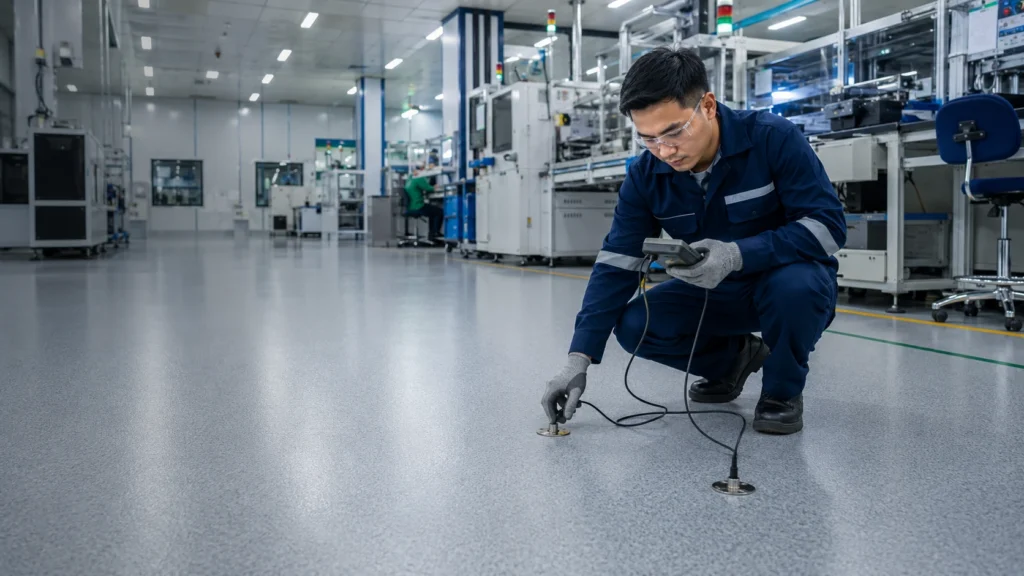
How Is ESD Flooring Tested?
Testing helps verify whether the installed flooring performs according to the required electrical criteria.
ANSI/ESD STM7.1 provides test methods for measuring the electrical resistance characteristics of flooring materials and flooring systems.
Depending on the ESD program, additional testing may also evaluate the combined performance of the flooring, footwear, and person.
This is important because satisfactory flooring resistance alone does not automatically confirm that the complete personnel grounding system will perform as required.
Testing should follow the applicable standard and approved project requirements.
Measurement locations, equipment, test voltage, environmental conditions, acceptance criteria, and documentation should also be considered.
A single resistance reading should not be treated as proof that an entire facility is ESD compliant.
Does ESD Flooring Need Maintenance?
Yes.
Proper maintenance helps preserve both the physical condition and intended electrical performance of the flooring.
Routine cleaning should use products compatible with the flooring manufacturer’s recommendations.
Certain cleaning products, waxes, coatings, or residues may affect the electrical characteristics of some ESD flooring systems.
Periodic inspection and electrical verification may also be required depending on the facility’s ESD control program.
The maintenance and testing frequency should be based on the flooring system, traffic, operating environment, contamination level, internal procedures, applicable standards, and previous test results.
Common ESD Flooring Mistakes
Many ESD flooring problems begin during planning rather than installation.
Common issues include selecting flooring based only on an “anti-static” description, ignoring substrate condition, failing to consider the footwear and flooring combination, using an unsuitable grounding arrangement, skipping electrical verification, and using incompatible maintenance products.
Another common mistake is assuming that an ESD flooring material automatically makes an entire room ESD compliant.
ESD protection is a complete system.
The flooring is one important component within that system.
Frequently Asked Questions About ESD Flooring
ESD flooring helps manage electrostatic charge and provides a controlled path for charge dissipation when incorporated into a properly designed grounding and ESD control system.
Not necessarily.
Both flooring types are designed for static control, but they operate within different electrical resistance ranges.
The correct flooring depends on the process, equipment sensitivity, grounding method, footwear, facility requirements, and applicable ESD control program.
In many cases, yes.
The existing concrete should first be evaluated for cracks, contamination, moisture, flatness, strength, previous coatings, and other conditions that may affect installation.
Proper surface preparation is essential before the new flooring system is applied.
How do I know if ESD flooring is working properly?
Electrical testing should be performed using the applicable test methods and project acceptance criteria.
Depending on the facility, testing may include flooring resistance measurements and evaluation of the footwear and flooring system.
No.
ESD flooring helps control electrostatic charge, but it should not be presented as a system that eliminates every possible source of static electricity.
It works as one component of a broader ESD control strategy.
No.
The appropriate flooring depends on the components being handled, process sensitivity, equipment, personnel grounding method, customer requirements, facility ESD program, and applicable standards.
Conductive flooring should only be selected when it is appropriate for the specific application.
Choosing Flooring for a Real Facility
The right flooring decision begins with the actual operating conditions of the facility.
Production activities, substrate condition, traffic, grounding requirements, equipment, cleaning procedures, downtime limitations, and required electrical performance should all be reviewed before selecting an ESD flooring system.
See our completed flooring projects to learn how different flooring systems have been applied in actual industrial and technical environments.
ESD Flooring Philippines provides flooring solutions for industrial and technically controlled environments, including conductive and static-dissipative vinyl flooring, ESD epoxy flooring, ESD interlocking flooring, and raised access flooring.
Professional assessment helps determine which flooring system is most appropriate for the facility and its operational requirements.
Need Help Choosing the Right Flooring?
Share your facility requirements and site conditions. Our team can recommend a practical flooring system suited to your operation, safety needs, and performance goals.